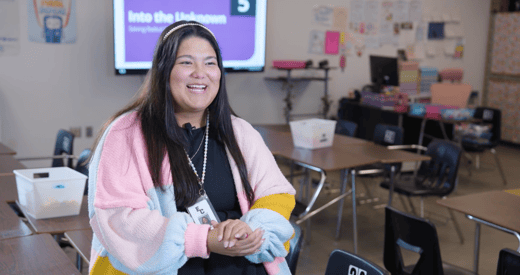
Leaving the Principal's Office for the Algebra Classroom
Timothy Duren has a phrase on his wall that he borrowed from Muhammad Ali: I am the world's greatest. It's been there since high school. It is, he'll tell you, not bragging–it's a reminder. And after the year he just had teaching eighth-grade algebra at KIPP Liberation College Prep in Houston, Texas, it feels pretty well earned.
But rewind about a year, and the picture looked a little different.
A return to the classroom
Duren has 17 years in education, most of them at KIPP Peace, the elementary school right next door to Liberation. He'd been a strong classroom teacher, strong enough that his principal invested in him and nudged him toward instructional leadership. He spent two years coaching teachers as an assistant principal before realizing something important: he loved what coaching could be, but he hadn't gotten the support to become the kind of coach he wanted to be.
"I knew what I could do in the classroom," he said. "I'd rather go back to what I know."
So in October of last year — right in the thick of the school year — he made the call. He was going back to the classroom. He was going to teach algebra. There was just one catch: he'd never taught algebra before.
He wasn't worried, though, and here's why: by the time those eighth graders walked into his classroom, he already knew most of them. He'd taught many of them back in fourth grade at KIPP Peace. He knew their parents. He knew their quirks, their stories, their potential. The relationship piece? Already handled.
"The rapport was already there," he said. "That made everything so much easier."
Trusting the curriculum, completely
When Duren arrived at KIPP Liberation, the school was rolling out Enhanced Bluebonnet Learning Secondary Mathematics. For Duren, that timing was actually a gift. Everyone was learning it together, which meant he wouldn't stick out as the new algebra teacher who didn't know the content. He could learn alongside his colleagues and his students.
He decided early on to go all in. No shortcuts, no workarounds, no "I'll just supplement with my own stuff." He was going to follow the Bluebonnet curriculum with fidelity.
"I was intentional about it," he said. "If KIPP Texas is going to put Bluebonnet in front of me, I'm going to do whatever it tells me to do. If I don't get the results, you have to blame Bluebonnet, because I did exactly what it said."
His first lesson? Independent and dependent variables. His coach chose that day to observe him. He fumbled. He actually stopped mid-lesson and asked his coach to model the rest of it for him.
She said no.
"She said, 'Duren, you've got this,'" he recalled. "And in that moment, I had to get out of my own head and do what needed to be done."
He did. And he never looked back.
Building a foundation of support
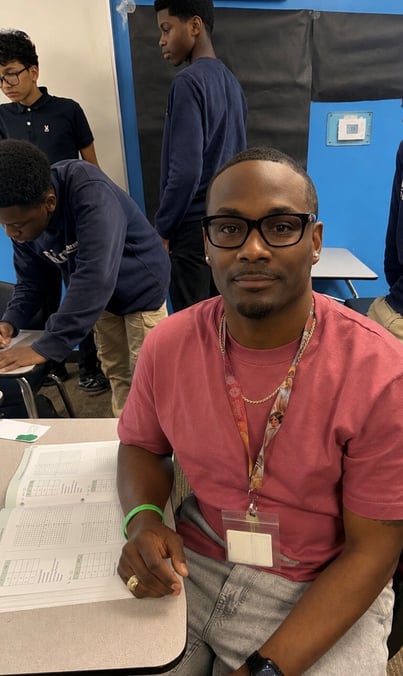 Timothy Duren
Trusting a brand-new curriculum is one thing. Getting the tools to actually teach it well is another.
Duren credits part of his fast start to Carnegie Learning's Professional Learning, live training sessions where teachers work directly with a PD coach to unpack classroom strategies, tools, and best practices tied to the curriculum they're using.
"Professional Learning was a great experience," he said. "It was valuable collaborating with other Algebra teachers and learning practical strategies and classroom tools they use every day. Our presenter really knew her stuff."
Duren also credits MATHia® as another piece of that support system. Carnegie Learning’s intelligent math software that adapts to each student in real time, offering individualized feedback and contextual hints as students work through problems, while giving teachers real-time data on exactly where each student needs support.
"I appreciate how MATHia gives students personalized practice while providing me with data to identify learning gaps and better target my instruction," he said.
The curriculum as a story
One of the most striking things about talking with Duren is how he describes the Bluebonnet curriculum not as a sequence of lessons or a pacing guide, but as a story.
"Every part, you needed that part to get to the next part," he said. "Chapter one helped me with chapter six. By the time we got to quadratics at the end, my kids could look at a graph and go, 'Mr. Duren, this is quadratic — remember in chapter one, we learned it goes like this.'"
He was especially intentional about the "Getting Started" portion of each lesson, which he used to spiral back to prior concepts, vocabulary, and visual representations. He color-coded his notes. He drew arrows. He made his thinking visible on paper right alongside his students' work.
"Whatever I put on the side for me, you could pull up a student book and it would look exactly like mine," he said. "I want to expose my brain on this paper."
His students noticed something else, too: the Bluebonnet lessons were harder than the state test. After their December interim assessment, kids started telling him the STAAR practice felt easy compared to what they were doing in class every day. He took that as a green light to stay the course.
"If they feel like Bluebonnet is a higher bar than where the state of Texas has set the STAAR test, and I'm getting my results, I'm sticking with Bluebonnet."
92% and counting
Duren walked into December with his students at 73% on the Approaches Grade Level benchmark, against a district goal of 80%. By March, they were at 78%. By May, when they sat for the final STAAR End-of-Course assessment, they hit 92% at the Approaches Grade Level performance level, well above the 80% target.
Out of 88 students, 80 passed. The eight who didn't were largely impacted by attendance issues, suspensions in other classes, or circumstances outside anyone's control in the classroom.
His student survey results were just as strong. On the Panorama survey administered in the spring, 92% of students said they felt safe to make mistakes in his classroom. Ninety-four percent said he challenged them to think.
Those aren't just feel-good numbers. Those are the kinds of numbers you build a culture on.
Relationships first, always
Ask Duren about his results and he'll tell you about algebra. Ask him about what made those results possible, and he'll tell you about relationships.
He starts every morning the same way. Students walk in, he greets each one by name. He asks what their mom cooked last night. He knows their birthdays. He shows up as a consistent, caring adult presence, something he knows some of his students may not find anywhere else.
"I don't know when the last time that child got a hug," he said. "I don't know if they have a father who comes home every day. But they know that at 8 o'clock in the morning, Mr. Duren is going to be there."
He's also radically honest with his students. When he came back from a week out due to a car accident, he told them exactly what happened. When he didn't understand something in the curriculum, he said so out loud. He invited them to stop him when something didn't make sense, and he meant it.
One of his eighth graders, Mateo, captured it perfectly in a written note shared at graduation. He told Duren that he'd watched him all year and noticed something: Duren had a distinct, individual relationship with every single student in the class. Not just "I know your name." He actually knew them.
"For him to pick up on that, he had to be watching me all year," Duren said. "That's why I am intentional. That's why I put in the work."
Advice for teachers coming to Bluebonnet
For any teacher picking up Bluebonnet for the first time, Duren has two pieces of advice:
First, come with an open mindset and be willing to be vulnerable. The rigor is real. You cannot pick up Tuesday's lesson Tuesday morning and wing it. You have to spend time internalizing the material, understanding not just what you're teaching, but why it connects to what came before and what comes next.
Second, trust the curriculum, and do it the way it was designed to be done. "The district is spending money on this curriculum," he said. "It has to show proof that it's working. If I can say I truly did what I was supposed to do, then we can have a real conversation about results."
His results speak for themselves.
What's next
Duren is planning to stay at KIPP Liberation for at least five more years. His next group of eighth graders? He was their assistant principal when they were younger. He already knows them. They already know him.
And he's already thinking about where to raise the bar, including more student-led discourse, tighter progress monitoring, deeper work on the spots where he knows the story could be told even more clearly.
"My goal is 100," he said, without a hint of irony. "I don't know if that's possible. But we're going for it."
If his first year in algebra is any indication, we wouldn't bet against him.
Find out how Enhanced Bluebonnet Learning Secondary Mathematics is raising the bar for algebra instruction in Texas.
|
The kids told me the STAAR test was way easier than what we do every day in class. I took that as a win. |
Timothy Duren
Math Teacher


Annie joined the Carnegie Learning team in 2025 after over two decades of marketing, communications, and administration experience in higher education. Committed to the belief that a quality education unlocks a meaningful life, Annie is dedicated to supporting educators in their mission to teach successfully and effectively.