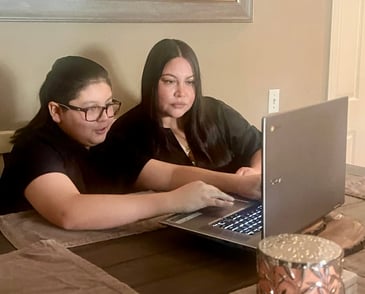
A murder mystery, a horse race, and an Easter egg hunt walk into math class.
Here's a question worth solving: What do Taylor Swift, Kevin Hart, Billie Eilish, and Cristiano Ronaldo have in common with a high school math classroom in San Antonio, Texas?
They were all suspects in a murder mystery. A math-based murder mystery, to be exact.
Welcome to Jessica Soto's Algebra 2 honors class at East Central Independent School District, where skills practice is anything but routine. Easter egg hunts. Jeopardy games. Horse races. A "Cooking or Cooked"-themed fortune cookie activity. And yes, a classroom whodunit starring some of the world's biggest celebrities.
This is what learning looks like when a great curriculum meets a teacher who runs with it.
Skills practice: the underrated MVP of math instruction
Before we get into the Easter eggs, let's talk about what skills practice actually is.
In our Middle and High School Math Solutions, skills practice is a core print component designed to reinforce the key concepts and skills from each topic. It's targeted. It's flexible. It's built for the moments when students need more time with a concept, more problems to work through, more confidence before they move on.
Skills practice is ideal for building fluency, supporting differentiated instruction, and making the most of dedicated practice time. It works alongside the consumable Student Edition, which puts the learning directly in students' hands in a tangible, write-in-it, own-it kind of way. Together, these print components give teachers and students something real to work with, no device required.
And here's the thing: that's a feature, not a limitation.
Research consistently supports the value of print-based practice for skill development and retention. A 2024 research review published in the Oklahoma Education Journal found that readers comprehended and retained less information when reading on digital screens compared to printed materials, a finding consistent across multiple studies.
Skills practice is built with that principle at its core: focused, repeated practice in a format that works for every learner, regardless of access to technology.
Meet the teacher who put skills practice in a plastic Easter egg
Jessica Soto is a third-year educator teaching Algebra 2 honors at East Central ISD. She has exactly one rule when it comes to skills practice: it does not have to be boring.
"I can still make it fun," she says. "My creativity doesn't have to disappear."
Every week, Soto designs at least one activity that takes skills practice questions off the worksheet and puts them somewhere unexpected. Her toolbox includes Jeopardy games (with an actual Jeopardy buzzer set), coloring sheets, gallery walks, horse race games with color-coded cardstock horses on a Promethean-board track, and escape-room-style decoder challenges tied to polynomial operations and complex numbers.
The Easter egg hunt? Students hunted for plastic eggs filled with logarithmic and exponential equations, solving each one and swapping with classmates to work through as many problems as possible.
Her students are 15 to 17 years old.
"I kind of wanted to bring the elementary aspect back into it," she says. And it worked. Parents have messaged her to say their teenagers came home talking about the math game they played in class. One student, described by Soto as exceptionally bright, spontaneously left her own group during the Easter egg hunt to walk a struggling student through the process. That kind of peer-to-peer learning, Soto says, helps both students.
"The higher-achieving students get to explain the process, which helps them process it even more," she says. "And for the lower-achieving students, it's someone they can relate to one-on-one."
For sophomore Evan Gawlik, it means he looks forward to math class. “Ms. Soto is always trying to keep us involved,” says Golic. “Today’s Easter egg hunt was super fun–I was locked-in pretty much the entire time. It was engaging. I really enjoyed it.”
“You’ve got to make it memorable somehow,” adds Gawlik. “You have to have fun activities so they stick with the students. You can’t just walk up there and write equations on the whiteboard and expect people to remember it. Math isn’t boring. It’s fun.”
A curriculum built to support every learner
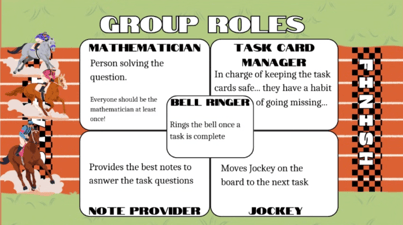 A slide from Soto's horse race
What makes this possible is a curriculum designed with flexibility baked in.
Our math solutions are built around low-floor, high-ceiling tasks, meaning every student can access the content, and every student can be challenged by it. The collaborative lesson structure puts students in conversation with each other from day one. And the Teacher Implementation Guide gives educators the scaffolding they need to deliver rigorous content with confidence, whether they're in their first year or their fifteenth.
"In the beginning, it may feel like a lot," Soto admits. "But after you get the hang of it, it feels like no work at all."
That confidence matters. Soto tracks her Common Formative Assessment data every year, and the results reflect what happens when a teacher trusts the process: mastery rates in her classroom have more than doubled since her first year, growing from roughly 10-12% to above 25%.
The curriculum also meets students where they are. East Central ISD serves a diverse population, including bilingual learners, students with special needs, and students from low-income households. Soto says Carnegie's built-in scaffolding means every student is working on grade-level content, and getting there.
"The rigor is where it's at," she says. "But we can still scaffold them and meet them where they need to be. And that's beautiful."
Print, on purpose
For districts weighing digital-heavy curricula against more balanced approaches, here's what Jessica Soto's classroom makes clear: print-based skills practice, done well, is not a fallback. It's a foundation.
Skills Practice and the consumable Student Edition give students ownership of their work. They write in it, return to it, and build fluency through repetition that sticks. And when a teacher like Soto gets her hands on those materials, a skills practice worksheet becomes an Easter egg. A horse race. A murder mystery with celebrity suspects.
"You can still take all of those skills practice questions," Soto says, "and just turn them into something fun and engaging for the kids."
Algebra 2 hasn’t been the same since.
Watch how East Central High School raised math sores with our Enhanced Bluebonnet Learning and Texas Math Solution
|
"The rigor is where it's at. But we can still scaffold (the curriculum) and meet the students where they need to be. And that's beautiful." |
Jessica Soto
Math Teacher


Annie joined the Carnegie Learning team in 2025 after over two decades of marketing, communications, and administration experience in higher education. Committed to the belief that a quality education unlocks a meaningful life, Annie is dedicated to supporting educators in their mission to teach successfully and effectively.