
(And Why You Should, Too!)
Dr. Amber Dumbuya didn't just want her students to read—she wanted them to think.
As the sole ELA teacher for grades 6–8 at Georgia's School for Arts Infused Learning, she'd watched too many students approach complex texts with either total overwhelm or surface-level answers. Previous curricula offered disconnected materials and a clunky platform. Worse, it had trained students to hunt for "canned and rote answers" instead of wrestling with what texts actually meant.
Then Dr. Dumbuya—Georgia's 2021-22 Teacher of the Year—found something different. Carnegie Learning's Lenses on Literature® gave her middle schoolers the one thing most curricula deny them: the tools to read like scholars, not just students.
When Close Reading Feels Like Guesswork
Before Lenses, Dr. Dumbuya noticed inconsistencies in how her students interacted with their textbook. 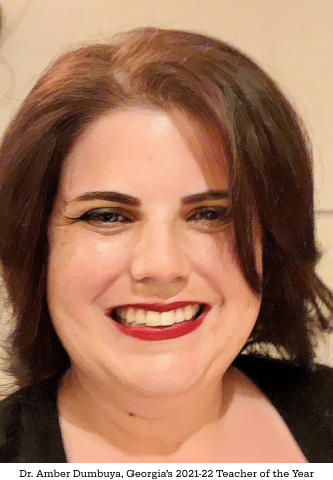 Some students over-annotated everything. Others barely marked their texts at all. Most significantly, there seemed to be no structured pathway for understanding complex literature, and student discussions meandered without the text at their center.
"Prior to Lenses, our instructional materials lacked coherence and didn't offer the structure, depth, or annotation support students needed to meaningfully grapple with complex literary texts," Dr. Dumbuya explained. "The previous curriculum had little space for engaging with the text, and the online platform was not user-friendly."
For a charter school with limited resources, every instructional decision matters. Dr. Dumbuya needed a curriculum that could support all readers in engaging with grade-level texts and tasks in a way that didn’t “water” them down.
Teaching Students How to Think, Not Just What to Think
What drew Dr. Dumbuya to Lenses on Literature wasn't flashy features or empty promises. It was the curriculum's core belief: that all students are capable of engaging with complex texts and tasks.
"Lenses offers the ability to treat middle schoolers as readers and thinkers," she says. "It doesn't water down texts, and it doesn't over-scaffold to the point that students can't think independently."
Instead of handing students a text and questions, Lenses teaches them to ask their own questions. It builds in time to revisit texts multiple times, analyzing different aspects each time through intentional "lenses" that make the invisible work of reading visible.
For Dr. Dumbuya, Lenses on Literature felt like the curriculum was designed around her teaching philosophy. It gave her and her students a shared language: when she said "Let's annotate for author's purpose," they knew exactly what she meant.
The impact was almost immediate.
Confidence, Independence, and Sophisticated Thinking
"Students who used to annotate randomly were suddenly annotating with purpose," Dr. Dumbuya recalls. "Discussions became more sophisticated. Their writing improved because their thinking improved."
The shift wasn't just about mechanics. It was about equity. Lenses gave every student—regardless of reading level—access to the same cognitive tools for tackling complex texts. The routine-based approach supported the school's MTSS initiatives, allowing Dr. Dumbuya to work with Tier 2 and 3 students on the same material as their peers.
"The learning environment feels more equitable because everyone has access to the same cognitive tools," she noted.
The features she loves most—annotation expectations, high-quality diverse texts, comprehensive lesson guides, and online support—all serve one purpose: developing students who can analyze complex literature at grade level.
Building Strong Readers and Thinkers
Asked about the most noticeable change in her classroom since adopting Lenses, Dr. Dumbuya was quick to point to student confidence.
“Students [are asking] deeper questions, analyze the author's purpose more effectively, and write more coherent short responses,” she said.
This matters especially at a school with an arts-infused mission, where students are already encouraged to think creatively and interpret the world from multiple perspectives. Lenses on Literature supports that approach by giving students structured pathways to analyze texts through different interpretive lenses—connecting directly to Georgia's emphasis on evidence-based thinking, academic vocabulary, and literary analysis.
"Lenses is rigorous, student-centered, and aligned to the demands of college- and career-ready standards," Dr. Dumbuya noted.
A Curriculum That Actually Teaches Thinking
When asked what she would tell other districts about Lenses on Literature, Dr. Dumbuya’s answer was direct:
"I would tell them that Lenses is one of the few ELA curricula that really teaches thinking. Many other curricula are rinse and repeat from what we used when I was in school."
"If your goal is to raise literacy achievement, build academic stamina, and give teachers a structured yet flexible framework with built-in rubrics, curriculum maps, and differentiation, Lenses is worth the investment."
Want to see how Lenses could transform reading instruction in your school or district?

Kelly joined the Carnegie Learning team in 2023, bringing a decade of diverse educational experience. Her career includes one year as a high school Dean of Students and nine years teaching French at secondary and post-secondary levels. An AP French exam reader in 2017 and 2020, Kelly holds ACTFL OPI certification and is versed in various world language pedagogies, including TPRS and Organic World Language (OWL).