How Lenses on Literature helped one Texas district strengthen teaching, improve English I outcomes, and expand its vision for literacy instruction.
Challenges:
- English I performance wasn't improving at the pace the district needed.
- A teaching team with varying levels of experience needed more consistent instructional guidance and support.
- Students needed more meaningful opportunities to write, analyze complex texts, and engage in rigorous grade-level instruction.
Solutions:
- Ongoing Carnegie Learning professional development support for implementation
Populations Served: Grades 9–12
Results:
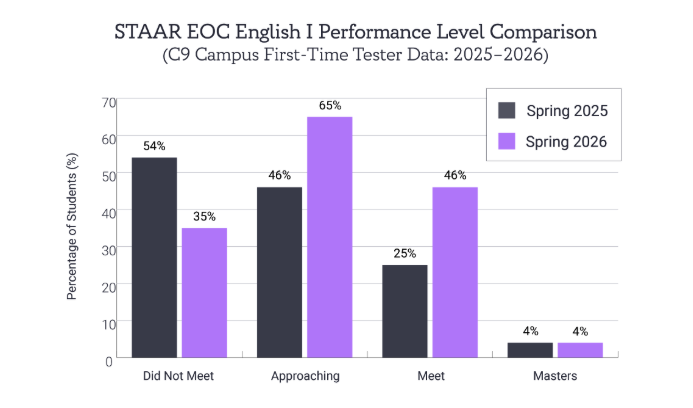
- English I End-of-Course (EOC) non-pass rate decreased from 54% to 35%, a 19-percentage-point improvement for first-time test takers.
- Growth in key accountability performance bands and fewer zero scores on extended constructed responses.
- Increased teacher confidence and stronger instructional practices, including modeling, scaffolding, and integrating writing into daily lessons.
- Greater student engagement, writing stamina, and confidence when approaching challenging academic work.
- Expansion of Lenses on Literature into grades 6–8 to establish consistent literacy instruction across grades 6–12..
Challenges to ELA instruction at Cleveland ISD
Cleveland Independent School District in Texas faced an urgent challenge: improving English I outcomes while supporting a teaching team with a wide range of backgrounds and experience. The district needed more than rigorous instructional materials. It needed an English Language Arts curriculum that would help teachers deliver effective grade-level instruction and give students the opportunities and support they needed to succeed.
With Lenses on Literature, weekly professional learning communities (PLCs), and ongoing support from Carnegie Learning, Cleveland ISD began building teacher expertise and changing what literacy instruction looked like in the classroom.
The results? A 19-percentage-point improvement in English I EOC non-pass rates for first-time test takers, growing confidence among teachers and students, and a successful high school implementation that inspired the district to expand Lenses on Literature into middle school.
Improving student outcomes while supporting a changing workforce
Cleveland ISD knew something had to change. English I performance wasn't improving at the pace district leaders needed, and they were working within a limited window to demonstrate meaningful growth.
At the same time, Cleveland ISD was navigating a reality familiar to many districts: a teaching team with a wide range of backgrounds and experience. From veteran educators to teachers just beginning their careers, the district wanted to ensure everyone had the instructional resources and support they needed to help students succeed.
Dr. Ashley Beeman, Secondary RLA Content Specialist at Cleveland ISD, explained why the district's existing curriculum wasn't meeting teachers' needs:
“It had great text. It just didn't have what we needed for the teachers to be able to fully teach those lessons.”
Writing instruction was another area of concern. Students needed more consistent opportunities to write, analyze texts, and strengthen their language skills. But without writing and grammar explicitly integrated into daily lessons, those priorities were often pushed aside.
Cleveland ISD needed an ELA curriculum that could address both challenges: rigorous, grade-level instruction for students and a clear instructional foundation for teachers. The goal was to give every teacher, regardless of experience, the tools and support to deliver rigorous literacy instruction effectively.
Rigorous instruction and the support teachers need
District leaders wanted rigorous, grade-level instruction that challenged students to think critically, engage with complex texts, and become stronger readers and writers: not a watered down curriculum that would make the work easier for students.
They also knew that rigorous instructional materials were only part of the equation. Teachers needed a clear path for bringing that instruction to life, especially for those still developing their ELA teaching expertise.
That's where Lenses made a difference.
With comprehensive teacher materials, student workbooks, and a digital platform, Lenses provided a consistent instructional foundation while giving teachers the flexibility to meet their students' needs.
The lessons were also accessible to teachers with different levels of experience. Rather than relying on specialized instructional terminology, they provided clear guidance that helped teachers understand the purpose of each lesson and how to deliver it.
As Dr. Ann Hill, Dean of Instruction and Instructional Coach at the Cleveland 9th grade center, explained, the lessons were written so that “even those who didn't have that pedagogy, they could understand what it was saying.”
For students, Lenses brought the elements district leaders had been looking for into daily instruction. Complex, grade-level texts remained central to learning, writing was integrated throughout lessons, and built-in scaffolds helped teachers support multilingual learners and students with disabilities without lowering expectations.
For Cleveland ISD, Lenses offered something essential: a rigorous ELA curriculum that supported students while giving teachers the instructional foundation they needed to help them succeed.
Building teacher support through collaboration and ongoing support
Adopting a new curriculum was only the beginning. To help teachers bring Lenses to life, the district paired its implementation with weekly professional learning communities (PLCs) and ongoing support from Carnegie Learning.
During PLCs, teachers worked together to internalize upcoming lessons, create exemplar writing responses, and anticipate where students might struggle. They also practiced teaching portions of lessons with colleagues acting as students, giving one another feedback and identifying opportunities to strengthen instruction before stepping into the classroom.
This collaborative approach helped teachers move beyond simply assigning work to modeling the reading, writing, and critical thinking they wanted students to demonstrate.
Rather than ending professional learning after the initial rollout, Carnegie Learning's team returned to Cleveland ISD several times to address real classroom challenges, participate in PLCs, answer questions, and model lessons with students.
That ongoing partnership stood out to Dr. Hill because “in typical curriculums, you don't have that. They just throw the curriculum out to you. They'll do the beginning of the year training. Bye-bye, we're gone, you know. And I've rolled out a number of new reading curriculums at different grade levels. So I was very impressed with the support from Carnegie.”
For teachers navigating a new curriculum and a more rigorous instructional approach, knowing they had a team to turn to made a meaningful difference.
Dr. Beeman recalled how a member of Carnegie Learning's professional learning team stepped in to support teachers when they needed additional guidance: “She jumped in and would model lessons for us with our students if we were struggling. She's like, I can do it. And I thought that, you know, you don't always get that. [...] But that just, I don't know, it helped the teachers buy in that they had this huge support team.”
That hands-on support helped teachers become more comfortable with the curriculum, strengthen their instructional practices, and build confidence in their ability to meet students' needs.
Stronger instruction, more engaged students
As teachers became more confident implementing Lenses, Cleveland ISD began to see meaningful changes in classroom instruction.
Teachers pivoted away from traditional “sit-and-get” instruction and increasingly modeled the reading, writing, and thinking they wanted to see from students. Students discussed texts, collaborated with peers, wrote throughout each unit, and returned to complex texts to justify their thinking.
Writing, in particular, became a consistent part of daily instruction. English I teacher, now Instructional Coach, Ashley Huckabay described the difference: “They wrote almost every single day. And it wasn't just a little bit of writing. It was substantial. And they were actually analyzing and synthesizing the things that they were learning.”
Teachers also began proactively identifying places where students might struggle and providing scaffolds and supports. This allowed students, particularly multilingual learners and students who needed additional support, to access the rigorous curriculum without lowering expectations.
For English I teacher Justin Thompson, those supports made challenging concepts more accessible to students: “The way Carnegie is able to break it down, it does it in a different way so that it's not elementary, but it still gets the information through.”
Together, these changes helped create classrooms where students weren't simply completing assignments. They were actively engaging with challenging texts, developing their ideas, and building confidence in their ability to read, write, and think critically.
A 19-percentage point improvement in English I performance
Those instructional changes weren’t only visible in the day-to-day classroom experience. By the end of the year, they were showing up in student performance too.
After just one year of Lenses, the district has plenty to celebrate. The English I End-of-Course (EOC) non-pass rate fell from 54% to 35%—a 19-percentage-point improvement among first-time test takers.
The district also saw significant growth at higher performance levels. The percentage of first-time test takers scoring Approaches Grade Level or Above increased from 46% to 65%, while those scoring Meets Grade Level or Above jumped from 25% to 46%—a 21-percentage-point gain.
Beyond these performance gains, teachers also reported fewer zero scores on extended constructed responses.
How to read this chart
STAAR performance levels are cumulative, not mutually exclusive: students in higher tiers (Masters and Meet) are automatically included in the lower tiers (Approaches), while Did Not Meet is the only standalone category.
The district's progress extended beyond first-time test takers, with an overall 11-percentage-point decrease in students who did not meet grade-level expectations when including those retaking the English I EOC assessment.
While these numerical gains were encouraging, some of the most meaningful signs of progress weren't found in the score report. Students who had spent the year tackling challenging reading and writing daily were willing to stick with the EOC assessment for four or five hours. Some even told their teachers that the state assessment felt easier than the work they had been doing in class.
For Dr. Beeman, the impact came down to something bigger than a test score: “I think it has helped create or build more confidence in our students that they can read, they can write. They just needed the opportunity or the supports to get there.”
From English I success to a 6-12 vision for literacy
Cleveland ISD had already implemented Lenses across grades 9–12, and the success in English I gave stakeholders confidence in the approach to literacy instruction.
That success sparked the expansion of Lenses into grades 6–8, establishing a more consistent approach to literacy instruction across middle and high school.
For teachers, that means a shared instructional framework, common classroom routines, and collaborative practices. For those new to the district or the profession, it means stepping into an established system of support rather than building one from scratch.
The district hopes that consistency will pay off for students, too. Instead of high school teachers having to establish new routines from the ground up, they can build on the reading, writing, and critical thinking students have already practiced in earlier grades and push them toward even deeper levels of analysis and achievement.
With measurable improvements across English I performance levels after just one year of Lenses, the district is encouraged by the potential for continued year-over-year growth as teachers and students become increasingly familiar with the curriculum.
What started in high school is now becoming a foundation for literacy instruction across grades 6–12.
Ready to see how Lenses could play a role in changing literacy outcomes for your district?
- Lenses on Literature
- CLEVELAND INDEPENDENT SCHOOL DISTRICT
- CLEVELAND, TEXAS
- ENROLLMENT: 12,711
Cleveland Independent School District DEMOGRAPHICS:
- Grade Level: Pre-K-12
- Race: Hispanic/Latino - 86.27%, Black or African American - 3.7%, White - 8.5%, Two or more races - 1.2%, Asian/ Pacific Islander - 0.2%, American Indian/ Alaska Native - 0.1%
- Economically Disadvantaged: 92.5%
- Students With Disabilities: 15%
- English Learners: 61.6%

It built that confidence in them that they could do it. And it built the confidence in the teachers that they could teach the way the students needed and reach students and bridge those gaps that they had.
Dr. Ann Hill, Dean of Instruction and Instructional Coach, Cleveland ISD